
Thread standards: Standards and differences
Without standardization, life in an industrialized and globalized world would not be possible. We take it for granted that we can always buy a replacement part at the hardware store that will fit just as well as the original. But for this to work, manufacturers have to adhere to certain standards.
Fixed standards are essential for threads to be able to work effectively at all. Not only on an industrial level do thread standards ensure that production runs smoothly. Even if you want to cut a thread yourself at home, you should know exactly which type of thread you are working with. And sometimes that's not so easy, because the diversity among thread standards can quickly make it difficult to keep track. As a manufacturer of threading tools, it is important to us at BAER that you can finish your work successfully and with pleasure. That is why we would like to present you with a clear overview of all the common thread standards that you should know.
This is how the standards for threads can be divided
When it comes to thread standards, there are many terms in circulation that can cause additional confusion. We will try to shed some light on the subject and explain the criteria that can be used to distinguish between thread types.
International differences
Thread types have each undergone their own developments in different countries. We are still a long way from a single, globally standardized thread standard. Instead, there are international differences in the standards for threads, each with more or less scope. We will discuss the most important international threads in more detail later.
Movement thread and mounting thread
Thread types can also be subdivided according to their areas of application. We refer to standards for threads designed for fastening components as fastening threads. The classic screw, for example. Movement threads, on the other hand, are threads that are used to transmit a movement. Many common thread standards such as the trapezoidal thread or the round thread fall into this category.
Fine thread and coarse thread
Many thread standards include standards for coarse thread and fine thread. These two variants complement each other well, each bringing its own strengths. The coarse thread is the thread type for all normal fastening screws and nuts. The thread standards for fine threads, on the other hand, provide for a smaller pitch. This means that less distance is covered per revolution, which allows fine adjustment, e.g. for adjusting screws.
What thread types have to do with the profile
Thread standards basically refer to a collection of parameters that precisely define the profile of a thread. With the dimensions that the thread standard specifies, you can therefore imitate the thread profile at any time and completely without a template. And this leads precisely to the interchangeability that thread standards are designed to achieve.
The most important parameters found in the thread standard include the outside diameter (also called the nominal diameter), the flank angle and the pitch. These values can also be found in the abbreviated designations of the corresponding standards for threads. In this way, you can easily check which thread standard is involved for each tap.

You should know these thread standards
You don't have to know every single thread standard perfectly. But if you have already heard of the most common standards for threads, then it will be easier for you to identify a particular thread standard in the future. You can then easily read the exact characteristics from a table and do not have to know them by heart.
The ISO metric thread
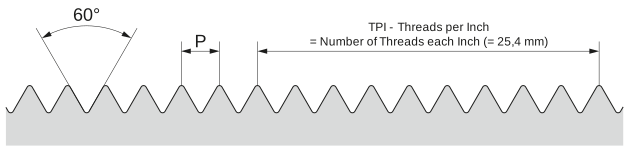
The ISO metric thread is the thread standard you will deal with most often. In fact, it is the thread standard that is most widely used throughout Europe. As the name implies, all dimensions are given metrically, i.e. in mm. The flank angle is 60°. In this thread standard, the pitch refers to the distance between two thread tips. This means that the pitch corresponds exactly to the distance that can be covered in one revolution. The designation for this thread standard consists of the letter M and the specification of the nominal diameter.
In addition to the metric standard thread, there is also a thread standard for the metric fine thread. Here, the flank angle is also 60°, but the pitch is smaller.
The American Unified Thread Standard (UTS)
American thread types are widely used in the USA, but also far beyond. Some of these thread standards have made it as far as Japan or Australia.
In contrast to the metric ISO thread, all dimensions of the American threads are given in inches. Pitch is also defined differently; it is the value of threads per inch. So to calculate the actual pitch, you need to divide an inch by that number.
The most important thread standards among the American standards for threads are the American coarse thread Unified National Coarse Thread (UNC) and the American fine thread Unified National Fine Thread (UNF). All American thread standards have a flank angle of 60° and are designated by the nominal diameter in inches followed by the abbreviation (e.g. UNC or UNF).
The British Whitworth thread
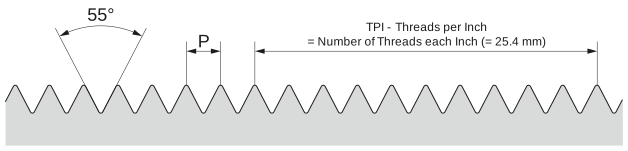
With the exception of pipe threads, British thread standards are largely restricted to Great Britain and its sphere of influence. British threads gain special significance from the fact that they are the world's oldest thread standards. in 1841, the British engineer Joseph Whitworth defined these standards for threads, which are still named after him today.
The dimensions are also given in inches for the British threads. The flank angle is 55°, which distinguishes them from metric and American threads. Particularly significant threads are the British Standard Whitworth Coarse Thread (BSW) and the British Standard Fine Thread (BSF).
Other interesting thread standards
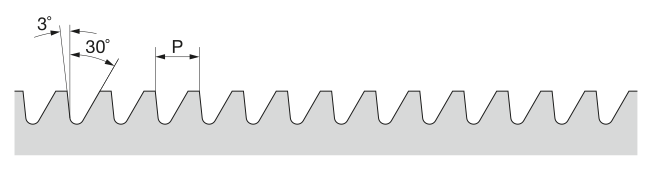
Other common thread standards that you may encounter in your work are the trapezoidal thread (Tr), the round thread (Rd) and the saw thread (S). These thread standards are often used for movement threads, for which they are predestined due to their special profiles.
In addition, there are numerous thread standards, some of which are very special, such as the valve thread (Vg) or the C-mount thread from the photographic sector.
Wide range of thread standards in BAER Online-Shop
Regardless of which thread standard you are looking for, you will find it at BAER Online-Shop ! As a tap manufacturer, we have made it our business to stock even rare or unusual thread standards for you. And if you need further advice on thread standards, feel free to contact our customer service.